Article re-cap
- You must place an emergency triangle 45 metres behind damaged vehicles, ensuring it faces oncoming traffic to provide a buffer for approaching drivers.
- Under South African road law, you are legally required to remain at the site of a collision until the police have officially arrived.
- Leaving the scene of an accident is a criminal offence that can result in a fine of up to R180,000 and or imprisonment for up to nine years.
- If a collision involves any injury or fatality, you are legally required to report the incident within 24 hours.
- Drivers must exchange full names, identity numbers, physical addresses, telephone numbers, vehicle descriptions, and registration numbers at the scene.
The collision happens in seconds. Your hands shake, adrenaline floods your system, and suddenly you're standing on the roadside unsure what to do next. South African road law leaves no room for guesswork-there are specific, non-negotiable steps you must follow.
Secure the scene first
The first move is not to check your phone or call a mechanic, but to establish a perimeter. You cannot manage the legal fallout if you are part of a second collision.
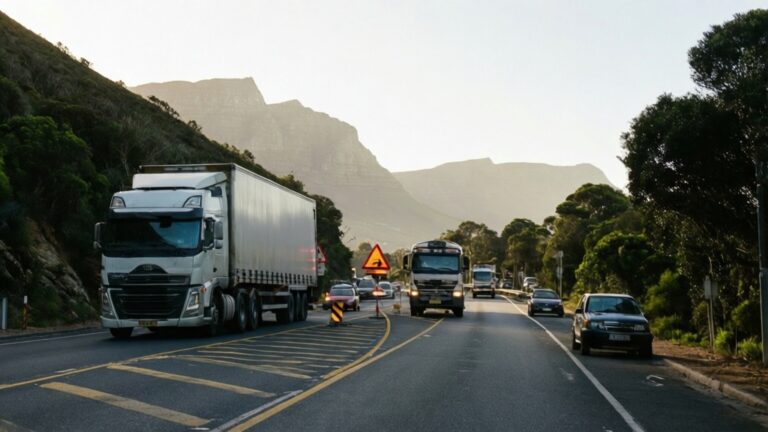
You must place an emergency triangle 45 metres behind the damaged vehicles, ensuring it faces oncoming traffic. This distance is not arbitrary; it provides the necessary buffer for approaching drivers to react to the obstruction on the road.
Neglecting this step creates a deficit in scene safety. If the triangle is placed too close or incorrectly positioned, you are essentially inviting further impact into an already unstable situation.
If someone is injured
Before attending to documentation or information exchange, check whether anyone at the scene requires urgent medical attention. If a person is injured, call SAPS on 10111 or an ambulance on 10177 immediately. Do not wait for the situation to become clearer before making the call; early contact with emergency services can determine the outcome for an injured person. Stay on the line and follow the dispatcher's instructions. Continue to keep bystanders clear of oncoming traffic while you wait for help to arrive.
Why you must stay at the scene
The impulse to exit the scene is often driven by a desire to avoid confrontation or lengthy delays. This is a fundamental error in judgement. Under South African road law, you are legally required to remain at the site of the collision until the police have officially arrived.
Leaving the scene is not merely a procedural lapse; it is a criminal offence. The state treats hit-and-run incidents with extreme severity because they undermine the accountability of the entire road network. If you are found to have fled, you face a fine of up to R180,000 and/or imprisonment for a period of up to nine years.
The cost of avoiding a difficult conversation is far too high to justify. Whether the incident occurs in Table View or Milnerton, the legal consequences remain fixed. You must stay until the authorities arrive to document the event and ensure all parties are accounted for.
When and how to report the accident
The timeline for reporting an accident is not a matter of convenience, but a strict legal requirement. If the collision involves any injury or fatality, you are required to report the incident within 24 hours. This window is non-negotiable when human life is involved.
In cases where there are no injuries and only property damage has occurred, the law allows for a slightly different approach. You must ensure the report is made on the first working day following the event. The clock starts ticking as soon as the vehicles are cleared from the road.
When you go to the police station to report, you will be required to complete the SAPS 176 Accident Register form. This is the official document that creates the formal record of the collision, and it underpins any subsequent insurance or legal proceedings. Bring all the information you exchanged at the scene, because an incomplete SAPS 176 entry weakens your position considerably.
Do not assume that a mutual agreement between drivers exempts you from this duty. It remains an offence to fail to report an accident where property has been damaged or a person has been injured, even if both parties have decided not to pursue legal action. The obligation to notify the authorities exists independently of any private settlement or intention to claim.
What information to exchange
The paperwork is not a formality; it is the foundation of your claim and your defence. If you fail to capture the correct data, the SAPS 176 entry becomes useless for any subsequent legal or insurance proceedings. You cannot rely on memory once the adrenaline fades or the tow truck arrives.
Every driver involved has a duty to provide specific identifiers. Ensure you record the following items accurately:
- Full names and identity numbers
- Physical addresses and telephone numbers
- Vehicle descriptions and registration numbers
- Details extracted from the vehicle licence discs
Precision matters here. A misspelled surname or a digit missed on a registration number creates a gap in the audit trail that is difficult to close later.
Why the paperwork matters more than the damage
A dented fender is a mechanical problem, but a missing signature is a legal liability. People often treat the aftermath of a collision as a purely physical event, focusing on the wreckage and the immediate inconvenience. This is a fundamental error in calculation.
The paperwork serves as your primary defence against future claims or investigations. When you fail to document the exchange of identity numbers, addresses, and vehicle registration details accurately, you are essentially leaving the door open for disputes that no amount of insurance can settle. On paper, an undocumented accident is an unverified event.
The cost of cutting corners is rarely visible until a summons arrives or a claim is rejected. If your conduct at the scene does not align with the statutory requirements, you are not just dealing with a broken car; you are facing the possibility of criminal prosecution and unrecoverable financial loss.
For the full picture, read How to handle a car breakdown in Cape Town.
Frequently asked questions
What should I do first after a car accident in Cape Town?
The first priority is to secure the scene by establishing a perimeter. You must place an emergency triangle 45 metres behind the damaged vehicles, facing oncoming traffic; this provides a necessary buffer for other drivers on the road to react to the obstruction.
Is it legal to leave the scene of an accident in Table View or Milnerton?
No, you are legally required to remain at the site of the collision until the police have officially arrived. Leaving the scene is a criminal offence; if found guilty of a hit-and-run, you could face a fine of up to R180,000 and or imprisonment for up to nine years.
How quickly must I report a car accident to the authorities?
If the collision involves any injury or fatality, you must report the incident within 24 hours. In cases involving only property damage with no injuries, you are required to make the report on the first working day following the event.
Do I still need to report an accident if both drivers agree not to take legal action?
Yes, it remains an offence to fail to report an accident where property is damaged or a person is injured. The obligation to notify the authorities exists independently of any private settlement or mutual agreement between the drivers involved.
What details should I collect from other drivers at the scene?
To ensure your SAPS 176 entry is valid for insurance or legal proceedings, you must accurately record full names, identity numbers, physical addresses, telephone numbers, vehicle descriptions, registration numbers, and details from the vehicle licence discs.
Source: pagelschulenburg.co.za, aa.co.za, legal-aid.co.za, arrivealive.mobi, southafricain.com, dsclaw.co.za, legalwise.co.za