
Article re-cap
- The South African Triage Scale (SATS) is used in trauma units to prioritise patients based on clinical risk rather than arrival time.
- Patients categorised as Orange in the triage system must be seen within 10 minutes of arrival.
- True emergencies requiring immediate medical attention include chest pain, difficulty breathing, and uncontrolled heavy bleeding.
- When calling for help from a mobile phone in South Africa, you should dial 112.
An ambulance siren cuts through midnight in Bloubergstrand. You face a binary choice: drive yourself or wait for professional help. The answer depends on clinical severity, not panic.
How does the triage system work?
The triage process is a clinical calculation, not a queue based on arrival time. When you enter a trauma unit, the medical staff uses the South African Triage Scale (SATS) to determine how much risk a patient carries . This system was developed by the South African Triage Group to standardise care across different facilities . It removes the element of personal grievance from the waiting room because the priority is strictly dictated by physiological stability.
The hierarchy begins with Red, which denotes a state where immediate resuscitation is required. In these cases, there is no waiting period; the patient moves straight to active intervention. Orange follows as a very urgent category, meaning the patient must be seen within 10 minutes . This level of care addresses high-risk situations that are not yet terminal but could become so without rapid assessment.
Yellow represents urgent cases where you can expect to be seen within one hour . While this is a significant delay if you are in pain, it indicates the patient is stable enough for a short period of observation. Finally, Green denotes non-urgent arrivals. For these patients, the wait time may stretch between 4 and 8 hours, or you might be redirected to a day clinic entirely . The logic of the system ensures that those in the Red and Orange categories are never delayed by someone in the Green category, regardless of who drove themselves to the hospital.
What counts as a true emergency?
Identifying a true emergency
Distinguishing between an ER visit and a GP appointment is about identifying life-threatening symptoms versus manageable ailments. The distinction relies on whether the condition poses an immediate threat to vital functions or if it can be managed within a standard clinical window.
Genuine emergencies requiring immediate attention include chest pain or pressure, difficulty breathing, and uncontrolled heavy bleeding. You must also seek urgent care for loss of consciousness, seizures, sudden weakness, or severe physical trauma. These are the cases that trigger high-priority triage levels because they cannot wait for a scheduled consultation.
Non-emergencies that should be managed via a local practitioner include flu symptoms, mild rashes, chronic pain flare-ups, or repeat prescription requests.
What do you do in a crisis?
When a crisis occurs, your communication must be precise. If you are calling from a mobile phone, dial 112 . For landlines, use 107 . For city-specific incidents in Cape Town, you can also reach the City of Cape Town emergency line on 021 480 7700 . If you require direct private ambulance services, Netcare is available at 082 9111 and ER24 at 084 124 .
Emergency contact procedures
When speaking to a call taker, do not provide vague descriptions. You must provide the exact location of the emergency, including the closest cross street or a recognisable landmark in areas like Milnerton or Sea Point . This level of detail is what determines how quickly a unit can be dispatched to your position.
Upon arrival at the hospital, bring your ID and clinic card if available. If you lack identification, the facility will still treat you by assigning a temporary hospital number, but having documentation speeds up the administrative audit trail .
Navigating local emergency care
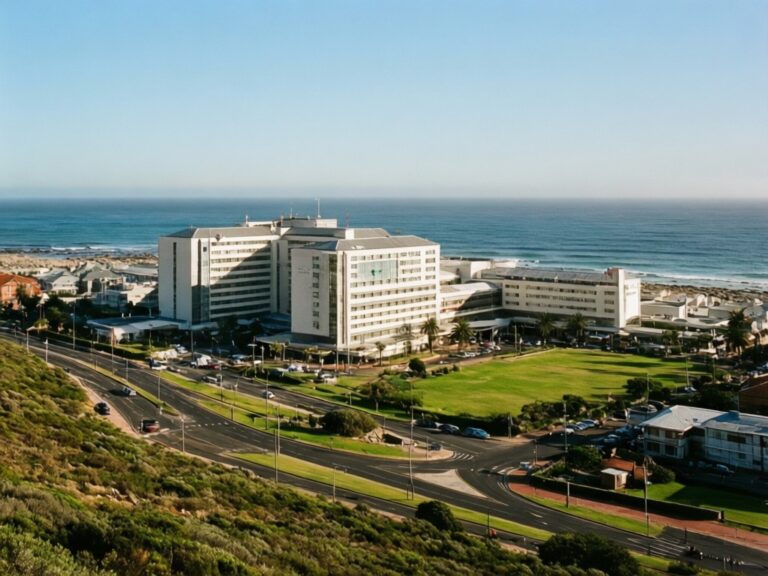
For further context on the healthcare facilities serving areas such as Table View, Parklands, and Bloubergstrand, refer to our guide: How to find hospitals and emergency care on the West Coast.
Frequently asked questions
How does the hospital triage system work in Cape Town?
Medical staff use the South African Triage Scale to determine care priority. Red category patients require immediate resuscitation with no waiting period, while Orange patients must be seen within 10 minutes. Yellow cases are seen within one hour, and Green cases may wait between 4 and 8 hours.
What symptoms should be treated as a medical emergency?
You should seek urgent care for life threatening symptoms such as chest pain, difficulty breathing, uncontrolled heavy bleeding, loss of consciousness, seizures, or severe physical trauma. These conditions require immediate attention because they pose an immediate threat to vital functions.
What are the emergency contact numbers for medical assistance?
If you are calling from a mobile phone, dial 112; for landlines, use 107. For direct private ambulance services in the area, you can contact Netcare at 082 9111 or ER24 at 084 124.
What information should I provide when calling an ambulance?
You must provide precise communication to the call taker, including your exact location. Mention the closest cross street or a recognisable landmark in areas like Milnerton or Bloubergstrand to ensure emergency units can be dispatched quickly to your position.
Source: wesgro.co.za, expatica.com, mediclinic.co.za, emssa.org.za, clinicfinder.co.za