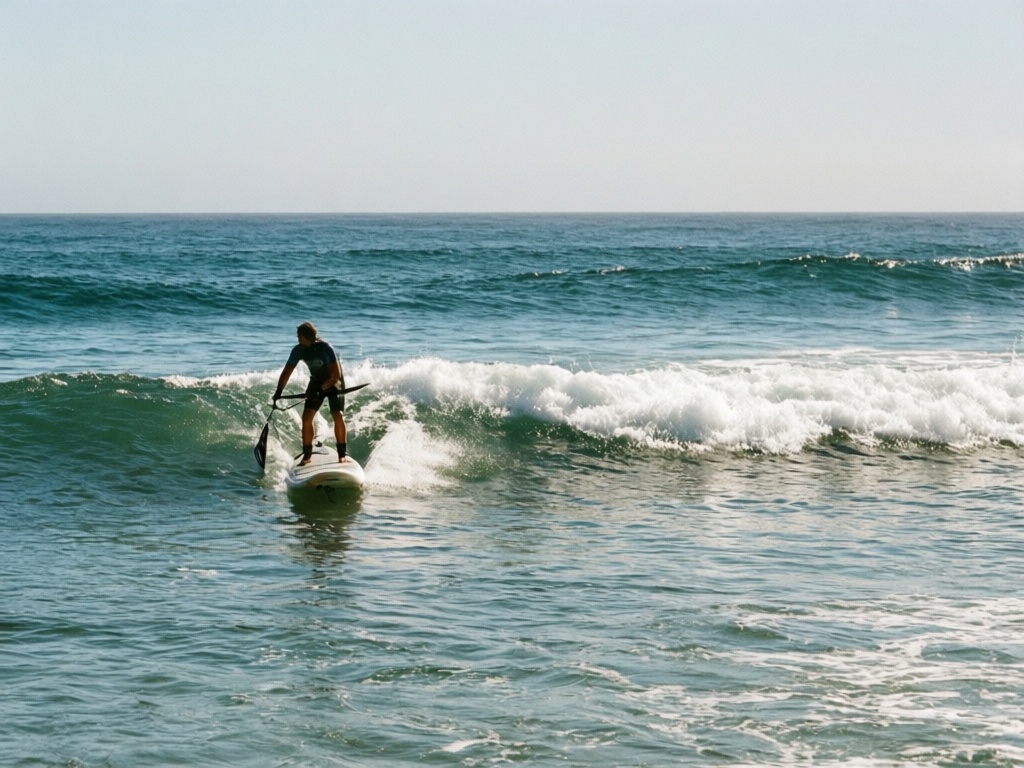
Article re-cap
- New paddleboarders should practice in flat water, such as canals, to build muscle memory and balance before attempting to navigate ocean swells.
- Beginners should focus on mastering the transition from kneeling to standing and refining their vertical paddle stroke without the distraction of waves.
- Essential gear for stand up paddleboarding includes a wetsuit for temperature regulation, a flotation vest, a stable board, and an appropriately sized paddle.
- Rental services in the area typically require you to leave an original passport or ID document as a deposit for the duration of your hire.
- Table View and Big Bay are primary hubs for paddleboard development, with downwind sessions extending from Milnerton through to Bloubergstrand.
The wind picks up across Table Bay, turning a calm surface into a choppy, unpredictable mess before you have even found your balance. This is the primary barrier to entry for new paddleboarders: attempting to master technical skills in high-energy ocean environments.
Why flat water comes first
Learning in moving ocean swells is inefficient because the external variables of wave force and tide overwhelm the internal mechanics of balance. The energy of a breaking wave introduces too many uncontrolled movements to allow for proper technical development.
To build the necessary muscle memory, you must first find flat water. This environment allows you to focus entirely on the relationship between your centre of gravity and the board's stability without the distraction of external surges. Using canals for this initial stage is a standard approach for those starting out .
Without a swell, you can practice the fundamental sequence of movement without interruption. This includes mounting the board while maintaining a low centre of gravity and transitioning from kneeling to standing without destabilising the craft. You can then refine the vertical paddle stroke so that it pulls the board forward rather than pulling your body toward the paddle, while learning how to recover your balance after an unexpected wobble.
If you skip this phase and move directly into heavy surf, the physical exhaustion of fighting waves will prevent you from learning the actual technique. You will simply be surviving the session rather than mastering the sport.
What gear you need and how to access it
Essential gear and local logistics
Proper equipment serves as your primary safety system. While advanced users may bring their own kit, beginners should rely on a complete set that includes a wetsuit for temperature regulation, a flotation vest for buoyancy, a stable SUP board, and an appropriately sized paddle. Many lesson providers supply all of this: a wetsuit, flotation vest, stand up paddleboard, and paddle are included as part of the session .
When accessing gear through rental services, there are specific administrative requirements to note. Most providers require an original passport or ID document to be left as a deposit, which is kept at the store for the duration of the rental . For context on cost, board rental at the Waterfront is priced at R300 for one hour, while a structured SUP lesson runs R650 for one hour . These figures give you a practical baseline when comparing providers along the coast.
There is also a clear distinction between a student and a renter. Rental services generally expect clients to be fully independent and competent paddlers. If you have not yet mastered the basics in flat water, you should seek out structured lessons rather than attempting to rent equipment for solo use.
Instruction and locations
Several established locations for instruction exist along the coast. For those requiring highly controlled environments, Hout Bay, Clifton, and Muizenberg offer various conditions depending on the day, and provide established settings where conditions can be managed for a more predictable introduction to moving water. In the more northern stretches, Table View, Big Bay, and downwind sessions from Milnerton to Bloubergstrand provide different challenges as your proficiency grows.
Specialised services like Cape Town Surf School operate in the Big Bay area, providing a mobile approach to water sport lessons . Other providers, such as Ocean Riders, offer instruction and hire across Hout Bay, Clifton, Muizenberg, Table View, and Big Bay, including downwind sessions from Milnerton to Bloubergstrand .
The utility of any specific location is tied directly to the wind. A spot that appears calm can become unusable in minutes if the wind shifts. Because conditions change so rapidly, you must assess the local environment before committing to a session.
How to progress into open water
The transition from controlled environments to the ocean requires a measured increase in complexity. Once the mechanics of paddling and balance become instinctive, you can begin to introduce environmental variables like light swell or tidal movement. This progression moves you from the stillness of canals to the predictable rhythms of sheltered bays.
Moving into open water involves managing the interaction between your board and moving energy. As your proficiency grows, you can move beyond simple stability to navigate more dynamic conditions. For those looking to expand their repertoire into more wave-driven disciplines, understanding the fundamentals of ocean movement is also essential for learning how to surf. For the full picture, read How to Start Surfing on the Cape Town West Coast.
Mastery comes from repeated exposure to controlled difficulty.
Frequently asked questions
Where is the best place to learn stand up paddleboarding near Bloubergstrand?
For beginners, starting in flat water like canals is ideal for learning balance. As you progress, Table View and Big Bay offer great development opportunities. For more advanced downwind sessions, you can paddle from Milnerton through to Bloubergstrand, depending on the daily wind conditions.
What equipment do I need to rent for paddleboarding?
A complete set of essential gear should include a stable SUP board, an appropriately sized paddle, a flotation vest for buoyancy, and a wetsuit to help with temperature regulation. If you are renting, remember that most providers will require an original ID or passport as a deposit.
Can I rent a paddleboard if I am a complete beginner?
Rental services generally expect clients to be independent and competent paddlers. If you have not yet mastered the basics in flat water, it is better to seek structured lessons from providers like Cape Town Surf School or Ocean Riders rather than attempting to rent equipment for solo use.
Are there professional instructors available in the Big Bay area?
Yes, several services operate in the area. Cape Town Surf School provides mobile lessons specifically near Big Bay. Additionally, providers like Ocean Riders offer instruction and hire across various locations, including Big Bay, Table View, and even downwind sessions stretching from Milnerton to Bloubergstrand.
Source: supcapetown.co.za, capetown.citypass.co.za, oceanriders.co.za, wikideals.co.za, capetown-watersports.com, openocean.africa, stokedsurfschool.com, insideguide.co.za