
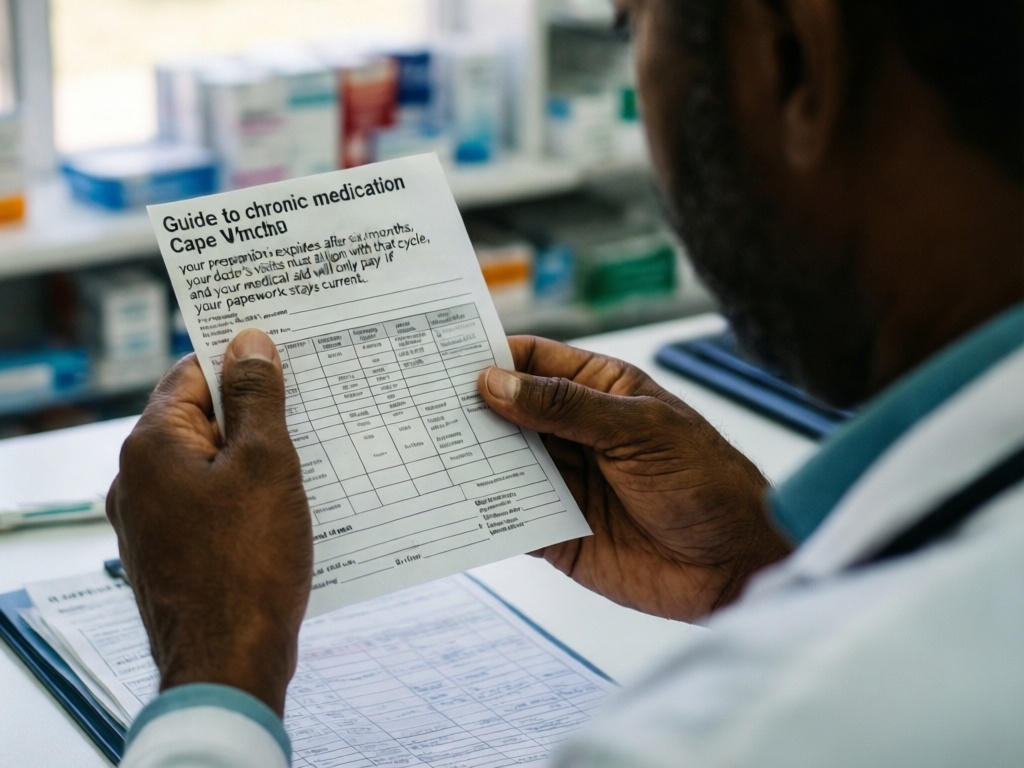
Article re-cap
- A prescription in South Africa can only be repeated for a maximum period of six months.
- Patients must visit their doctor at least every six months to ensure the medicine is working and to obtain new scripts.
- Medical schemes are legally required to cover diagnosis and management costs if a condition falls under the Chronic Disease List (CDL).
- Using a pharmacy outside of your medical aid's Designated Service Provider (DSP) network can lead to much higher out-of-pocket costs.
- Prescribed Minimum Benefits (PMB) ensure that schemes must pay for specific treatments and care in full without co-payments or using savings.
How long does a prescription actually last?
You stand at the pharmacy counter in Sea Point, looking at a small slip of paper that says 1 out of 6, only to find the pharmacist shaking his head because the date on your script has expired. It is a frustrating moment, but it is one that happens because people forget that a prescription is not a permanent permit; it is a temporary instruction with an expiry date. The law is quite clear on this: a prescription can only be repeated for six months. After that, the paper is just scrap.
Managing chronic medication requires more than just keeping the bottles full in your cupboard. You have enough to worry about without the medicine running out mid-month. You have to manage the cycle itself.
When you see a doctor for your regular check-up, they must monitor how the medicine is working, which means you need to visit them at least every six months. If you skip the doctor, you cannot get the new script, and the pharmacy cannot legally dispense the repeats. This is where people run into trouble with their medical aid. You might think your benefits are set for life, but if your paperwork is stale, the claim will bounce.
What does your medical aid actually cover?
The paperwork for a long-term illness is rarely as simple as it looks on the surface. If your condition falls under the Chronic Disease List, or CDL, the medical aid is legally required to cover the costs of your diagnosis and management. There is also the matter of Prescribed Minimum Benefits, known as PMB. These are specific conditions where the law dictates that your scheme must pay for the treatment and care in full, without making you pay a co-payment or dipping into your savings.
The fine print in the formulary
It sounds like a clean deal, but there is always a way for the costs to creep up on you. Schemes often use medicine formularies and treatment protocols to keep their spending in check. This means they might only agree to pay for one specific brand or a certain type of generic. If you show up at the pharmacy with a different version, you might find yourself paying the difference.
Managing your provider network
The schemes also use Designated Service Providers, or DSPs, to control where you go for care. While the law says you have the right to choose your own pharmacy and no pharmacist can force you into their preferred chain, choosing a shop outside of that DSP network can be an expensive mistake. You might find that the convenience of the chemist in your local neighbourhood ends up costing much more than the petrol spent driving to the one that actually plays by your medical aid rules.
How do you stay ahead of the paperwork?
To avoid the headache of empty bottles and unpaid claims, you must treat your prescription renewal like a scheduled service for a machine. Do not wait until the last pill is gone to start thinking about the next one.
Check your script carefully for those numbers-the 1 out of 6 or 2 out of 6 notation-to know exactly how many repeats are left. It is a simple way to track your progress before you run out of stock. Map out your doctor's visits to align with that six month limit, as they must see you regularly to monitor how the medicine is working.
If you stay ahead of the paperwork, the medicine flows and the medical aid stays quiet. It is much cheaper to pay for a consultation on time than to try and fix a broken claim after the fact.
At the end of the day, the real cost is not the medicine itself, but the time lost trying to fix a situation that could have been handled with a bit of foresight.
Your chronic script action checklist
Use this checklist each time you collect your chronic medication to keep the six-month cycle on track.
- Note the repeat number on the script (for example, 1 out of 6 or 3 out of 6) so you always know how many collections remain before the script expires.
- Book your next six-month doctor visit before the current script expires, not after; if you miss the appointment window you will not be able to get a new script and the pharmacy cannot legally dispense further repeats.
- Confirm with your scheme whether your regular pharmacy is a Designated Service Provider under your plan; using a pharmacy outside the DSP network may mean you pay more out of pocket even if your condition qualifies as a PMB.
- Ask the pharmacist for the dispensing date each time you collect, and note it somewhere you will find it; this lets you track the six-month window and plan your doctor visit and next collection well in advance.
Frequently asked questions
How long is a prescription valid for in Cape Town?
A prescription is not a permanent permit; it is a temporary instruction with an expiry date. According to the law, a prescription can only be repeated for six months. After this period, the paper becomes invalid and cannot be used to dispense medication at a pharmacy.
Why do I need to see my doctor regularly for chronic medication?
You must visit your doctor at least every six months because they are required to monitor how the medicine is working. If you skip these regular check-ups, you cannot get a new script, and pharmacies cannot legally dispense your repeats, which may cause medical aid claims to fail.
Will my medical aid pay for all my chronic medication costs?
If your condition is on the Chronic Disease List (CDL), your scheme must cover diagnosis and management. For Prescribed Minimum Benefits (PMB), schemes must pay for treatment in full without co-payments. However, be aware that formularies may limit coverage to specific brands or generics only.
Can a pharmacist force me to use a specific pharmacy?
No, the law states that you have the right to choose your own pharmacy, and no pharmacist can force you into their preferred chain. However, you should check if your pharmacy is within your medical aid's Designated Service Provider (DSP) network to avoid expensive costs.
Source: scriptpharm.co.za, angloms.co.za, drganesen.co.za, justanswer.com, profmed.co.za, sadag.org, propergroup.co.za, scielo.org.za