Article re-cap
- About 100 demonstrators marched in Cape Town on Saturday demanding the removal of undocumented foreign nationals, organised by March and March ahead of a 30 June deadline.
- A standoff with police over traditional weapons delayed the march, which eventually commenced peacefully after protesters surrendered their sticks and knobkieries.
- On 30 June, marches took place in the Cape Town CBD, Kraaifontein, and Wallacedene, with no major incidents reported by the City of Cape Town's Disaster Coordinating Committee.
- Many township SMMEs and foreign-owned shops reduced trading hours or closed on the day of the shutdown due to fears of intimidation.
- Post-event analysis praised inter-agency cooperation between SAPS, municipal law enforcement, and private security, while warning that underlying structural compliance gaps remain unresolved.
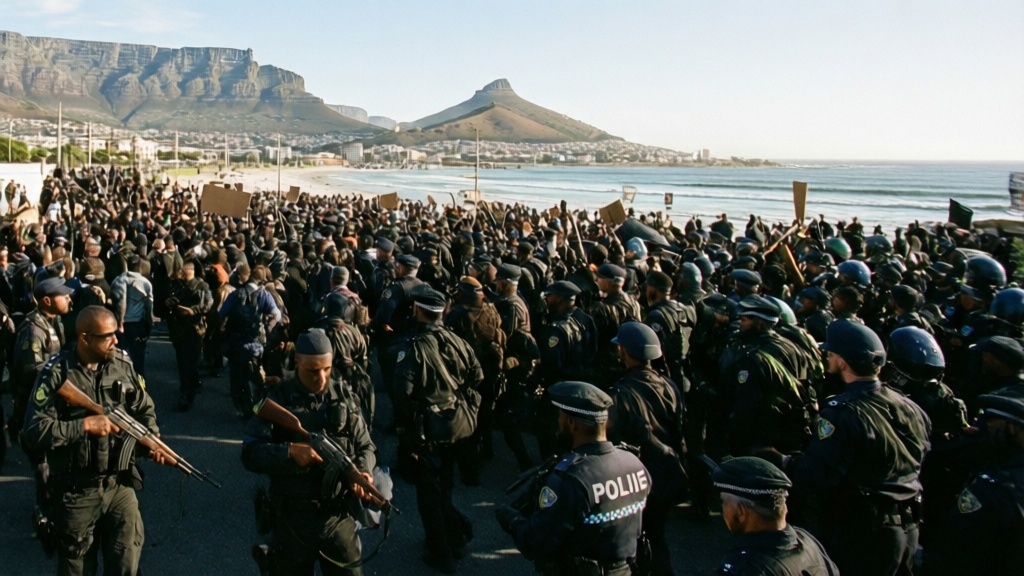
About 100 demonstrators marched through a Cape Town suburb on Saturday to demand the removal of undocumented foreign nationals.
The March and March organisation held the demonstration as part of nationwide protests ahead of a 30 June deadline some groups have referenced for illegal foreign nationals to leave the country. The group blamed undocumented individuals for rising crime rates, specifically human trafficking and drug abuse.
The protest comes ahead of a 30 June deadline some groups have referenced for illegal foreign nationals to leave the country.
The march began with a standoff between demonstrators and law enforcement at a church gathering point just after 9am on Saturday. Public Order Police and City of Cape Town Metro Police, equipped with riot shields, stun grenades, and rubber bullets, challenged the protesters over the brandishing of sticks and knobkieries.
Protesters eventually surrendered their traditional weapons before the march commenced shortly after 11am. March leader Busisiwe Sicetsha stated that the protest was intended to be peaceful and aimed at securing a future for South African generations.
Police spokesperson Constable Ndakhe Gwala confirmed the march was lawful and that no injuries were reported. Protesters were verbally warned to put away weapons and complied, he said.
Acting Minister of Police Firoz Cachalia has criticised organisers of planned nationwide protests linked to the demonstrations, saying the action is causing economic, financial, human and diplomatic harm. He warned that those who organise disruptive behaviour accompanied by violence could face criminal prosecution and civil liability for damages.
On Tuesday 30 June, the day of the shutdown deadline, authorities monitored a march on Wale Street in the Cape Town CBD outside the Western Cape Provincial Parliament. Two civil groups merged along Wale Street and protested together. Separate marches took place in Kraaifontein along Botfontein Road and in Wallacedene, with services on scene at each location. The City of Cape Town's Disaster Coordinating Committee said it had no confirmed record of any major incidents linked to the shutdown. No incidents were reported as linked to the Wale Street gathering.
Ahead of the 30 June shutdown, the City of Cape Town activated area-based Joint Operations Centres managed by the Disaster Coordinating Team in Goodwood. The City's Safety and Security Directorate worked in close support of SAPS and the Department of Home Affairs to deal with possible disruptions. Key priorities included preventing violence and protecting the public, maintaining public order across all four metropolitan areas, and ensuring a swift, visible and coordinated response to any incident of intimidation, looting or violence. Peaceful marches had been reported as planned in areas including Nyanga, Khayelitsha, Mitchells Plain, Philippi, Du Noon, Joe Slovo and the Cape Town CBD.
Mayor Geordin Hill-Lewis said Metro Police and Law Enforcement officers had been deployed across Cape Town to ensure public safety. He travelled on a MyCiTi bus from Parklands on the morning of the shutdown, describing the service as operating normally though slightly quieter than usual, and urged residents to continue with their daily routines. Mayoral Committee Member for Safety and Security JP Smith confirmed the City's Disaster Coordinating Team had received no reports of incidents linked to the shutdown by 7:30am. Smith noted that some businesses employing foreign nationals had allegedly been threatened and urged business owners and anyone subjected to intimidation to report these incidents to the South African Police Service for investigation. The City also made available an anonymous tip-off line on 0800 11 0077 for residents to notify authorities of any planned unrest, and its Disaster Risk Management Centre assisted with the coordination of humanitarian relief efforts at the Epping Refugee Centre. The City reminded residents to report emergencies or concerns to its Public Emergency Communications Centre on 021 480 7700.
A post-shutdown analysis has noted that the day was largely business as usual at major Cape Town workplaces, though the threat of instability left a mark on the small business sector. Many township shops and SMMEs, particularly those owned by foreign nationals, chose to shut down or reduce trading hours for the day. Where intimidation did surface, law enforcement responded quickly. The day also demonstrated civic cooperation, with real-time collaboration between SAPS, municipal law enforcement, and the private security sector. Civil society organisations and grassroots non-profit groups worked within communities to defuse tensions and uphold public order. Commentary following the shutdown has cautioned, however, that the structural compliance gaps driving community frustration remain unaddressed, and that managing symptoms rather than causes risks a repeat of the same cycle.
This is a peaceful march. All we want is a better South Africa for the great grandchildren of ours. I am a grandmother; I had to stand up because I want a future that is bright for my grandchild.
Frequently asked questions
What was the 30 June deadline referenced by protest organisers?
Some groups set 30 June as a deadline for undocumented foreign nationals to leave the country, prompting nationwide marches and a shutdown campaign on that date.
Were there any injuries or major incidents during the Cape Town shutdown on 30 June?
The City of Cape Town's Disaster Coordinating Committee confirmed no major incidents linked to the shutdown, and no injuries were reported in connection with the marches.
How did the shutdown affect small businesses in Cape Town?
Many township shops and SMMEs, particularly those owned by foreign nationals, chose to close or reduce trading hours on 30 June due to the threat of instability and intimidation.
What emergency contact numbers did the City of Cape Town provide during the shutdown?
The City made available an anonymous tip-off line on 0800 11 0077 for reporting planned unrest, and directed residents to its Public Emergency Communications Centre on 021 480 7700 for emergencies.
Source: ewn.co.za, capeargus.co.za, capetowner.co.za, smilefm.co.za, capechamber.co.za